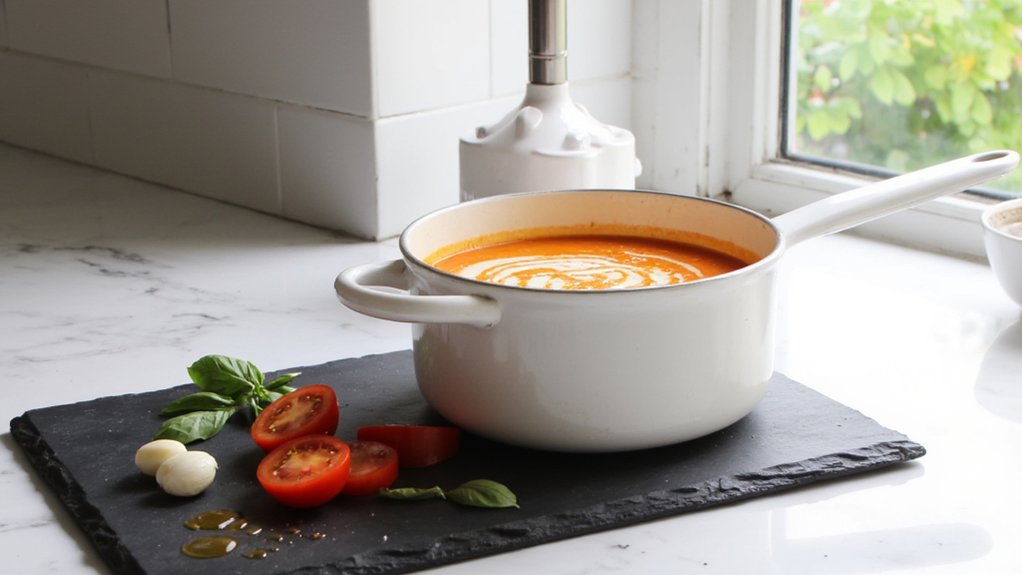
Ever notice how your immersion blender turns your soup into a Jackson Pollock painting? You’re probably tilting it wrong. There’s actually a sweet spot—a specific angle and depth combo that’ll keep your ingredients in the bowl instead of on your shirt. It’s not magic, just physics and a little technique adjustment. Stick around to find out what you’re missing.
Key Takeaways
- Hold the blender at approximately 45 degrees to balance power with control and reduce splatter effectively.
- Keep the blade head submerged at the optimal depth—deep enough to blend smoothly but shallow enough to prevent over-agitation.
- Avoid tilting too steeply, as steep angles increase turbulence and cause aggressive splashing and bubbling.
- Start blending at low speed and gradually increase to minimize surface disruption and maintain ingredient containment.
- Resist excessive movement; let the blender work steadily at a consistent angle to build smooth layers without mess.
Understanding the Physics Behind Splashing
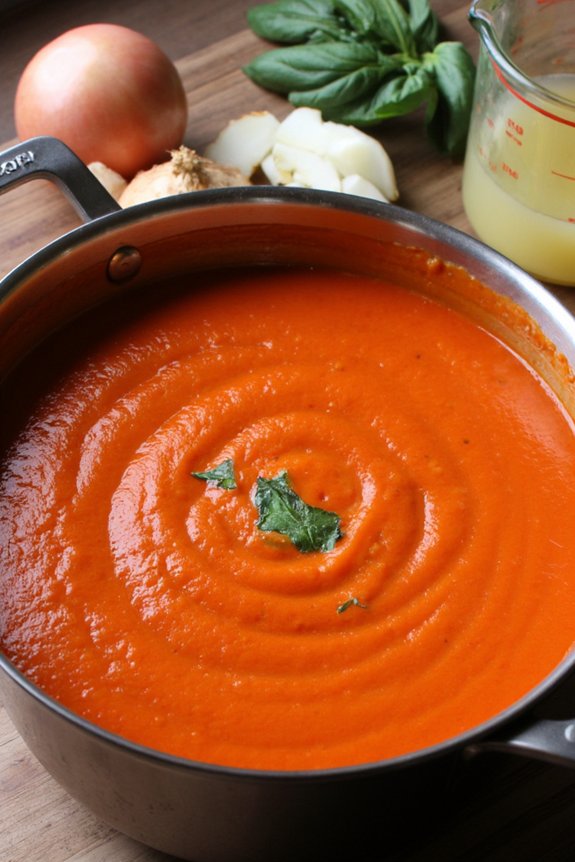
Beyond the basic up-and-down motion of your immersion blender, there’s actually some pretty interesting physics happening that explains why you’re ending up with soup splattered across your shirt. When you’re blending, you’re creating fluid dynamics at work, with liquids moving rapidly and colliding with air. Those collisions? They’re what causes splashing.
Here’s the thing: the faster your blender spins, the more energy it transfers to the liquid. That energy’s gotta go somewhere, and it often goes up and outward, creating spray. Understanding this helps you master spray mitigation techniques. By adjusting your blender’s depth in the liquid and angle, you’re actually controlling how that energy disperses. It’s not just luck when some folks keep their kitchens clean. They’re working with physics, not against it.
The variable speed settings available on many immersion blenders allow you to further control the energy transfer and help minimize splashing, giving you more precision when blending delicate or messy mixtures.
The Optimal Angle for Maximum Control
Tilt your immersion blender at roughly a 45-degree angle, and you’ll reveal the secret to keeping that soup exactly where it belongs, in your bowl. This angle calibration is your best friend when you’re trying to avoid that splatter situation.
Your wrist posture matters too. Keep your wrist relaxed and slightly bent, letting the blender do the work rather than forcing it. You’re not wrestling the thing, just guiding it. The beauty of this approach is that you’re working with physics instead of against it.
Start slow at the bottom of your pot, then gradually lift as you blend. This technique lets you control the vortex you’re creating. Once you nail this angle and posture combo, you’ll wonder why blending ever seemed messy.
For even smoother results, consider finishing with a cordless 360° swivel base kettle for adding a precise amount of hot liquid before blending.
How Blade Depth Affects Your Results
You’ve probably noticed that how deep you push that blender into your ingredients makes a huge difference in what you actually get—and it’s not just about looking cool while you’re doing it. When you keep the blade closer to the surface, you’ll get choppier results with more texture, which works great if you’re going for something rustic or want to keep some chunks, but go too shallow and you’re basically just splashing things around. Deep submersion, on the other hand, gives you that smooth, creamy consistency you’re after because the blade’s doing real work down there, pulling everything into the vortex and breaking it down more completely. The effectiveness of your blending can also depend on factors like blade design, which influences how ingredients circulate and how smooth your final result will be.
Shallow Blade Immersion Effects
Keeping your immersion blender’s blades shallow in the mixture creates surprisingly different results than plunging them deep. You’ll notice the difference pretty quickly once you start experimenting.
When you keep things shallow, here’s what happens:
- Edge turbulence creates more surface agitation, which means your ingredients churn around near the top rather than getting pulled down into the vortex.
- You’ll avoid blade cavitation, that annoying bubbling effect that happens when you go too deep and create air pockets.
- Shallow blending gives you better control over texture, letting you achieve chunkier results without working as hard.
The trade-off? You’re sacrificing speed for finesse. It’s like the difference between whisking and stirring, really. Perfect for when you want your soup a bit rustic or your sauce with some personality. Just like in coffee grinding, where blade depth and design impact texture and consistency, the immersion blender’s position can dramatically change your final result.
Deep Submersion Impact Results
Now, plunging those blades deep into your mixture is where things get serious. When you submerge your immersion blender fully, you’re unleashing the real magic of deep immersion. The impact results are genuinely impressive compared to shallow techniques.
| Depth Level | Texture | Processing Speed |
|---|---|---|
| Shallow (1 inch) | Chunky, uneven | Slower blending |
| Medium (2-3 inches) | Smoother consistency | Moderate pace |
| Deep (4+ inches) | Ultra-smooth, creamy | Rapid results |
You’ll notice that deeper submersion creates better circulation throughout your liquid. This means your blender actually reaches more ingredients faster, which translates to fewer lumps and smoother sauces. It’s kinda like the difference between stirring a pot and actually mixing things properly. The deeper you go, the more efficient everything becomes, honestly.
For even smoother results and to avoid motor strain, it’s helpful to consider motor power and performance when using any type of kitchen blending or grinding tool.
Positioning Your Blender for Different Consistencies
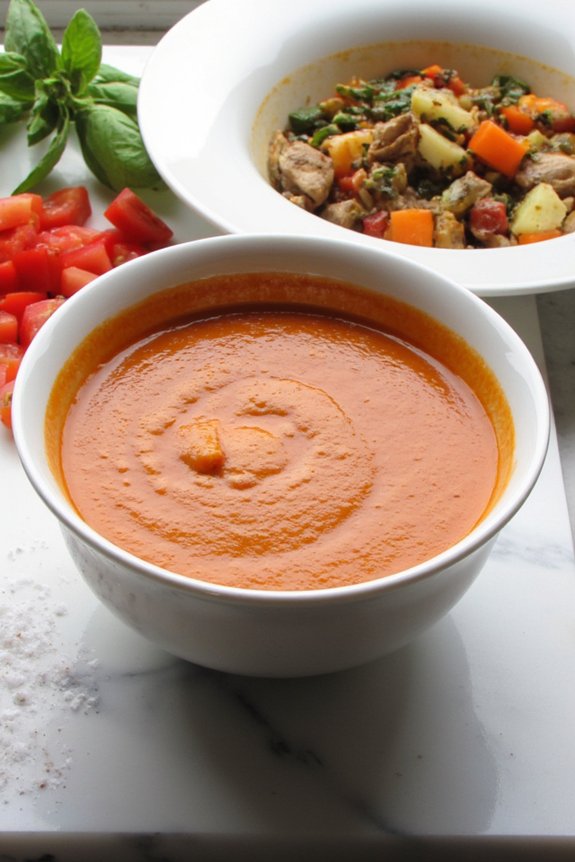
The angle you hold your immersion blender really does make a difference, and here’s the thing: you’ve got options depending on what you’re after. A shallow angle works great for soups where you want that silky, uniform texture, while a steep angle gives you better control and more aggressive blending for thicker sauces that need serious emulsifying power. For smoothies and anything in between, just aim for somewhere in the middle and you’ll find that sweet spot where you’re getting good blending action without splashing your kitchen like some kind of culinary disaster.
Shallow Angle for Soups
You’ll want to hold your immersion blender at a shallow angle—somewhere around 45 degrees or so—when you’re working with soups. This technique keeps things neat and prevents that annoying splashing everywhere.
Here’s why this angle works so well:
- It keeps the blade closer to the surface, which reduces turbulence and messy splatters on your stovetop or countertop.
- You’ll get better broth clarification because the gentler motion breaks down solids without creating excessive air bubbles that cloud your liquid.
- The shallow angle gives you more control for soup garnishing prep, letting you blend just the right amount without over-processing your ingredients into oblivion.
Basically, think of it like you’re guiding the blender rather than wrestling it. That shallow angle? It’s your secret weapon for smooth, splash-free blending.
Steep Angle for Sauces
When you’re working with sauces, it’s time to flip that blender angle on its head—literally. A steep immersion angle works wonders for thicker, more viscous mixtures. You’ll want to tilt your blender nearly perpendicular to the bowl, diving deeper into the sauce rather than skimming the surface like you’d do with soup.
This steep positioning lets you tackle denser consistencies without creating a splashy mess. The blade cuts through sauce viscosity more effectively when you’re going vertical. You’re basically punching down through the mixture, which prevents that annoying splattering that happens when you go shallow.
Start near the bottom and work your way up slowly. Your wrist angle matters more here than you’d think. Keep things steady and controlled, letting the immersion blender do its job without fuss.
Mid-Range Angle for Smoothies
Smoothies call for a completely different approach than the steep-angle business you’re doing with sauces. You’ll want to find that sweet spot right in the middle, where you’re getting optimal blending without creating a smoothie volcano situation.
Here’s what works:
- Hold your blender at roughly a 45-degree angle, which gives you the perfect balance between power and control for texture layering
- Use speed variation by starting low and gradually ramping up, letting ingredients incorporate smoothly without splashing everywhere
- Keep the head submerged but not too deep, finding that goldilocks zone where everything blends evenly
This mid-range angle lets you build those beautiful layers of fruit, yogurt, and liquid without fighting gravity or mess. You’re basically threading the needle between chaos and bland consistency.
Common Mistakes That Cause Messy Blending
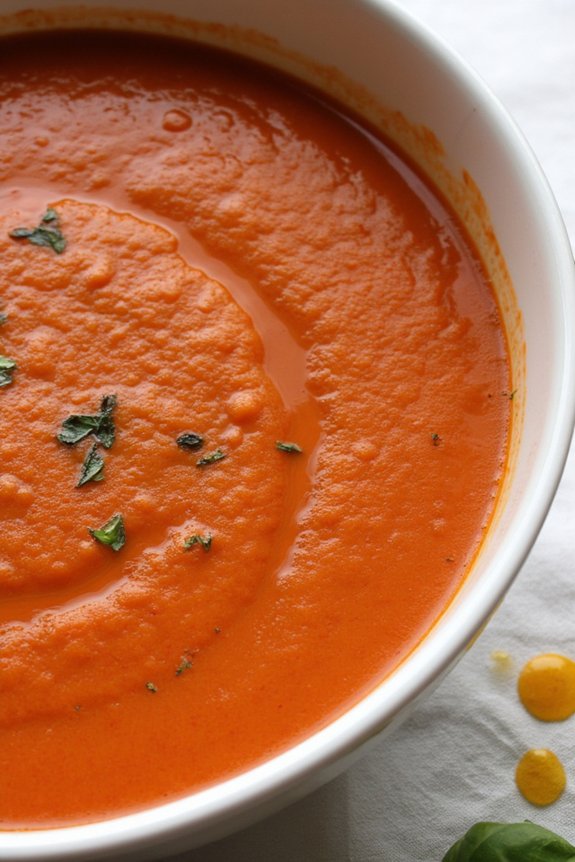
Most immersion blending disasters happen before you even press the power button, and they’re totally preventable. You’re probably tilting the blender at too steep an angle, which causes over agitation and splashing everywhere. Another biggie? Not filling your container enough. A half-full blender’s asking for trouble.
You might also be moving the blender around too much instead of letting it do the work. This creates uneven emulsification and turns your smoothie into a science experiment gone wrong. Plus, if you’re not securing the blender properly or using a container that’s too narrow, you’re basically setting yourself up for a messy situation.
Start slow, keep your angle steady, and resist the urge to stir constantly. Your kitchen will thank you.
Mastering the Technique With Hot Liquids
Hot liquids bring a whole new level of challenge to immersion blending, and honestly, they’re where a lot of people run into trouble. The steam rises, the heat’s intense, and suddenly you’re worried about splashes everywhere. Here’s what you need to know:
- Let things cool slightly before blending, giving you better hot safety and control over the whole process.
- Keep your blender submerged deeper in the liquid, which minimizes splashing and keeps things contained way better.
- Use lower speed settings for temperature control, letting you blend smoothly without aggressive bubbling that causes messy overflow.
You’ll also want to fill your pot only halfway, giving steam room to escape without erupting. Start slowly, feel how the blender responds, then gradually increase speed. Your patience here pays off big time.
Tips for Blending Various Food Types
Different foods require different approaches, and that’s where things get really interesting with your immersion blender. Soups? You’ll want consistent speed variation to avoid over-processing delicate ingredients. Fruits and veggies need texture pairing—think about what consistency you’re actually after before you start blending. Nuts and seeds demand patience. Go slow and steady, or you’ll end up with nut butter when you just wanted chunks. Dairy-based sauces require gentleness. A quick pulse works wonders here, keeping everything smooth without creating unwanted separation. Leafy greens blend faster than you’d expect, so watch closely. The key is matching your blending speed to what you’re working with, not blending everything at full throttle and hoping for the best.
Tools and Equipment That Enhance Performance
Raise your immersion blending game by surrounding yourself with the right gear.
- A gimbal stabilizer keeps your blender steady and reduces hand fatigue during longer blending sessions, letting you maintain that perfect angle without your wrist screaming at you.
- Silicone sleeves protect your blender’s shaft from wear and tear, plus they give you better grip control when things get wet and slippery in the bowl.
- A dedicated blending container with measurement marks saves you from guessing quantities and makes cleanup way easier than using random bowls.
These tools won’t transform you into a blending wizard overnight, but they’ll definitely make the whole process smoother. You’ll blend faster, with less mess, and your arms’ll thank you for the extra support.
Practice Exercises to Perfect Your Skills
Once you’ve got your gear sorted, it’s time to actually put in the work. Start with basic timing drills using water and ice in your blender. You’ll develop a feel for how long it takes to reach different consistencies, which is honestly half the battle. Practice your hand eye coordination by watching the blender’s contents while you’re working the immersion blender at that perfect angle. Try blending soups at various angles to see how the 45-degree sweet spot really does minimize splashing compared to straight-down approaches. Work with different liquid densities too—broth versus cream teaches you loads about pressure and positioning. Even five minutes daily builds muscle memory faster than you’d expect, and soon you’ll be blending without even thinking bout it.
Frequently Asked Questions
Can I Use the Angle Technique With an Immersion Blender That Has a Damaged Blade?
You shouldn’t use an immersion blender with a damaged blade. Safety concerns are significant—you’re risking injury and inefficient blending. Blade replacement is essential before attempting any technique, including the angle method.
How Long Does It Typically Take to Master the Immersion Blender Angle Technique?
You’ll typically master the angle technique within two to three weeks of consistent practice sessions. Focus on developing muscle memory through timing drills and recognizing visual cues for proper blade positioning and smooth blending motions.
What’s the Warranty Coverage if My Blender Breaks While Practicing This Technique?
Your blender’s warranty coverage depends on your manufacturer’s specific terms. You’ll need proper claim documentation and should verify warranty transferability if you’ve purchased secondhand. Check your product manual for details.
Are There Specific Immersion Blender Brands That Work Better With the Angle Technique?
You’ll find that high end brands like Breville and KitchenAid perform exceptionally well with the angle technique, though budget options from Cuisinart work reliably too. Your choice depends on frequency and durability needs.
Can the Angle Technique Reduce Blending Time Compared to Traditional Blending Methods?
Yes, you’ll find the angle technique reduces blending time through reduced turbulence and improved power efficiency. You’re directing energy more effectively into your ingredients, so you’ll achieve smoother results faster than traditional vertical blending methods.
Conclusion
You’ve got this. The 45-degree angle technique really does work, and once you nail it, you’ll wonder how you ever blended any other way. Start slow, keep that blade submerged, and gradually build speed as things break down. Practice a few times and you’ll be making silky soups without splashing your stovetop. Your kitchen cleanup routine will thank you.


