
Your immersion blender’s biggest secret? It’ll obliterate delicate textures into homogeneous mush while completely failing with anything thicker than soup. Those fancy multi-blade assemblies are engineered for silky smoothness, which means goodbye to rustic, layered complexity. Plus, high-speed vortices will splatter your kitchen if you’re not keeping that head fully submerged and vertical. They’re actually perfect for creamy soups and hot sauces blended right in the pot, but push ’em toward dense batters and watch the motor strain. There’s way more to maximizing yours without causing damage.
Key Takeaways
- Immersion blenders destroy delicate textures by creating irreversible purées, eliminating air pockets and rustic layers that alternative tools preserve.
- Motor damage occurs from blade overheating during continuous use, seal wear from forcing thick ingredients, and submerging the motor housing in water.
- High-speed blades create turbulent vortices that cause splatters; keeping the head fully submerged and vertical minimizes kitchen mess significantly.
- They’re unsuitable for thick, dense mixtures like cookie dough and heavy cake batter; stand mixers handle these tasks better.
- Immersion blenders excel at blending hot liquids directly in pots, eliminating dangerous transfers and reducing dishes compared to traditional blenders.
The Texture Problem: What Immersion Blenders Actually Destroy
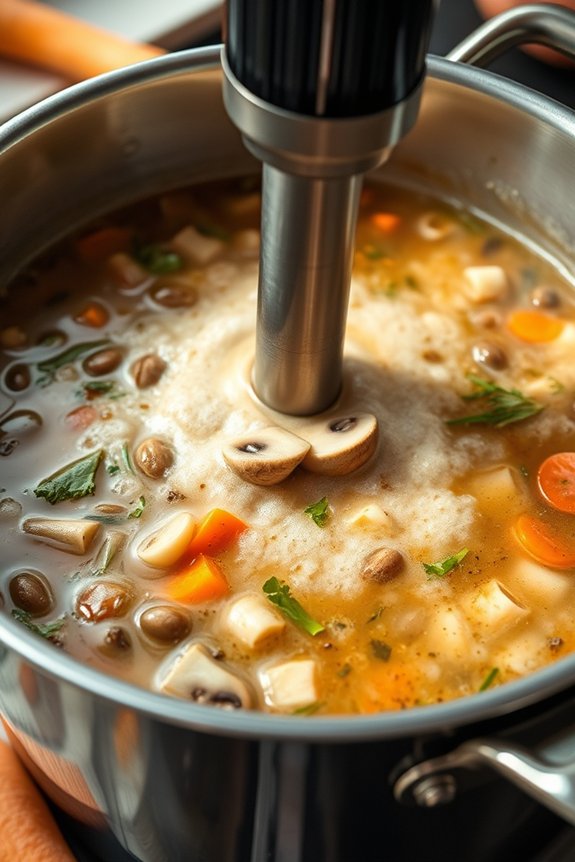
If there’s one thing immersion blenders are really good at, it’s turning solid food into something that’ll never be solid again. You’re not just breaking down ingredients, you’re destroying texture degradation that makes food interesting. When you blast that soup or sauce, you’re also causing aeration loss that strips away the delicate air pockets responsible for mouthfeel and complexity.
Here’s the thing: immersion blenders don’t discriminate. They’ll pulverize everything evenly, which sounds great until your carefully layered flavors become one homogeneous mush. That vibrant texture you’d get from a food mill or careful hand-crushing? Gone. Your creamy soup turns into something that feels almost too smooth, almost plastic-like. Sometimes rough and rustic beats perfectly blended.
Many immersion blenders use multi-blade assemblies that are engineered for maximum smoothness, which can further eliminate the subtle textures and layers that make certain dishes unique.
Why They Fail With Thick Batters and Dense Mixtures

Beyond the texture destruction we’ve already covered, immersion blenders hit a wall the moment you ask them to handle anything seriously thick or dense. You’ll run into some real problems here:
* Chunky resistance makes the blade work way harder than it’s designed for
- Blade cavitation happens when air pockets form, basically breaking suction
- Motor strain increases dramatically with denser mixtures
- The blender just spins without actually moving the mixture
- Potato-based soups become luxuriously smooth without losing flavor
- Dairy free creams made from cashews or oats blend perfectly into velvety textures
- Pan sauces emulsify butter and broth into restaurant-quality finishes
- Vegetable purées develop incredible depth when blended in-pot rather than cooled
- Seal wear caused by forcing the blender through thick ingredients or immersing it too deep
- Running it dry or blending extremely hard substances like ice repeatedly
- Submerging the motor housing in water, which shorts out electrical components
- Hot beverages: Making hot chocolate or warming soups directly in the pot without transferring to a blender
- Baby food: Blending small portions of soft foods right in your baby’s bowl, keeping cleanup minimal
- Small batches: Whipping up a single smoothie or sauce without hauling out your full-size machine
- Thick mixtures: Crushing ice or blending dense ingredients that’d clog a traditional blender
Here’s the thing: that powerful motor you paid for? It’s actually a liability with thick batters. Cookie dough, cake batter, heavy cream whips, they all create too much resistance. Your blender either stalls completely or makes this awful grinding sound that tells you something’s wrong. You’re better off using a stand mixer or doing it by hand. Your immersion blender wasn’t built for this heavy lifting. If you need to mix dense mixtures efficiently and safely, devices like high-powered stand mixers or sous vide immersion circulators with strong water flow and circulation are far better suited to the task.
The Splatter Science Nobody Warns You About

When you plunge that whirring blade into a liquid, you’re in effect creating a tiny tornado in a cup, and that’s where things get messy. Here’s the thing: high speed splatter isn’t just annoying, it’s actually physics in action. Those blades are moving so fast they’re basically flinging liquid particles in every direction imaginable. Your angle control matters way more than you’d think. Tilt that blender even slightly wrong, and you’ll wear more soup than you’ll actually eat. The real trick is keeping the head fully submerged and maintaining a straight, vertical position. Even slight angles cause liquid to escape up the sides. Pro tip: start at lower speeds before cranking it up, and you’ll notice way less kitchen cleanup happening around you. If you’re curious, this is why blade design and motor speed play such a critical role in how smoothly—and cleanly—your blending experience goes.
Foods That Are Secretly Perfect for Immersion Blending

You’d be surprised how many foods your immersion blender absolutely crushes that you probably aren’t using it for. Creamy soups and sauces are the obvious choices, sure, but have you ever tried whipping up homemade nut butters or spreads right in your blender—no fancy food processor needed? The thing is, these foods blend so smoothly and efficiently with an immersion blender that you’ll wonder why you’ve been overthinking it all along, especially when you realize how much easier cleanup is compared to dragging out bigger kitchen equipment. In fact, some immersion blenders can even rival the power and motor capacity of high-end smoothie makers, making them more versatile than most people realize.
Creamy Soups and Sauces
Creamy soups and sauces are honestly where immersion blenders absolutely shine. You’ll transform chunky ingredients into silky emulsions in seconds, no strainer needed. The magic happens right in your pot, keeping everything warm and fresh.
Here’s why you’ll love using them for this:
The best part? You’re not stuck with baby food consistency. Control your blending time carefully and you’ll nail that ideal thickness every time. Plus, cleanup’s way easier than dragging out your full-sized blender. Many kitchen gadgets, including immersion blenders and dishwasher-safe components, are designed for quick and easy cleanup.
Nut Butters and Spreads
Making nut butters and spreads at home is one of those kitchen tasks that seems like it should be complicated, but your immersion blender basically does all the work for you. You’ll be amazed at how these nutty emulsions transform from whole nuts into creamy perfection in minutes.
| Nut Type | Blending Time | Texture Result |
|---|---|---|
| Almonds | 8-10 minutes | Smooth & creamy |
| Peanuts | 6-8 minutes | Rich & thick |
| Cashews | 5-7 minutes | Silky & luxurious |
The beauty of seed dispersal through blending means you’re breaking down oils naturally without any weird additives. Just toss your nuts in, pulse steadily, and watch the magic happen. Your immersion blender handles the heavy lifting while you grab a spoon. Seriously, homemade nut butters taste infinitely better than store-bought versions.
Common Mistakes That Damage Your Appliance

While immersion blenders are pretty tough little tools, they’re not invincible. You’ve got to treat ’em right, or you’ll find yourself shopping for a replacement sooner than expected.
Here’s what’ll wreck your blender faster than you’d think:
* Blade overheating from continuous use without breaks, which can damage the motor
The key’s giving your blender breathing room. Take breaks between batches. Don’t go full throttle for minutes on end. Respect the seals by not pushing past what it’s designed for. Treat it like the kitchen workhorse it is, not a superhero, and you’ll keep it running smoothly for years.
Speed Settings and Technique Secrets the Manuals Don’t Mention
Most people just jam their immersion blender on high and hope for the best, but that’s honestly leaving a lot of performance on the table. Here’s what the manuals don’t tell you: variable revs are your secret weapon. Start on lower speeds for delicate tasks like emulsifying vinaigrettes or crushing ice gently. Once you’ve got your ingredients moving, bump it up gradually. The turbo pulse feature isn’t just flashy, it’s actually genius for breaking down tough stuff without overheating. Angle your blender at about 45 degrees, not straight down. Work it in small circles near the bottom of the container, letting it do the work instead of forcing it. You’ll get smoother results and way better control over your final texture.
When to Use Your Immersion Blender Instead of a Traditional Blender
If you’re whipping up a small batch of soup, your immersion blender’s your best friend because it lets you blend right in the pot without dirtying a huge traditional blender. You’ll save time on cleanup and won’t have that awkward situation where you’re juggling hot soup between containers, trying not to splash yourself like some kind of kitchen amateur. Plus, for just a couple servings, firing up a full-sized blender feels like overkill when you’ve got this handheld powerhouse ready to go.
When to Use Your Immersion Blender Instead of a Traditional Blender
Once you’ve got an immersion blender in your kitchen arsenal, you’ll start noticing situations where it’s actually the better choice over your traditional blender.
Here’s when to reach for your immersion blender instead:
You’ll appreciate how immersion blenders cut down on dishes and transfer time. They’re perfect when you’re not dealing with massive quantities. Plus, they’re way less intimidating than wrestling with a bulky traditional blender for quick tasks. Sometimes the simpler tool wins.
Small Batch Soups
Making a small batch of soup is exactly where your immersion blender shines, honestly. You’ll love how it handles smaller batch proportions without forcing you to work with a massive traditional blender that’s overkill for two or three servings. The real magic? You get incredible flavor concentration since you’re blending directly in your pot, keeping all those delicious juices right where they belong.
| Soup Type | Best Method | Why It Works |
|---|---|---|
| Cream-based | Immersion | Blends smoothly without splashing |
| Broth-heavy | Immersion | Maintains warmth and texture |
| Chunky vegetable | Immersion | Easy partial blending control |
| Pureed | Both work | Immersion wins on convenience |
Skip hauling out your full-size blender for weeknight cooking. Your immersion blender does the job faster, cleaner, and honestly, with way less cleanup involved. That’s the real win right there.
Frequently Asked Questions
Can Immersion Blenders Overheat, and How Long Is Safe Continuous Use?
Yes, your immersion blender can overheat. Most models have duty cycles—you shouldn’t run them continuously. Check your manual, but typically you’re safe blending for 1-2 minutes, then rest it before resuming. Motor overheating damages the appliance permanently.
What’s the Best Way to Clean Immersion Blender Heads Without Damaging Seals?
You’ll want to check if your immersion blender’s head is dishwasher safe before tossing it in. Use seal-friendly detergents and avoid harsh scrubbing that damages seals. Hand-wash gently when needed for maximum longevity.
Are Immersion Blenders Safe to Use in Non-Stick Cookware and Bowls?
You shouldn’t use immersion blenders in nonstick cookware because you’ll risk nonstick scratches that damage the coating. These scratches can trigger coating reactions, potentially releasing harmful particles into your food.
Do Immersion Blenders Work Effectively With Hot Liquids, and Any Safety Concerns?
You can blend hot liquids effectively, but you’ll want to let them cool slightly first. They’re designed for heat handling, though steam can cause splashing. Keep the blender’s head fully submerged for better splash control and safety.
Can You Blend Frozen Ingredients With Standard Immersion Blenders Without Motor Damage?
You shouldn’t blend frozen chunks with standard immersion blenders because you’ll create excessive blade stress on the motor. The frozen ingredients are too hard, and you’ll likely damage or burn out your motor permanently.
Conclusion
So here’s the thing: your immersion blender’s actually pretty great once you stop fighting it. It’s not trying to be a regular blender, and that’s totally fine. Stick to soups, sauces, and smoothies where it shines. Skip the thick batters, respect the speed settings, and you’ll keep splatters minimal. Use it right, and you’ve got yourself a seriously handy kitchen tool that’ll last years.


